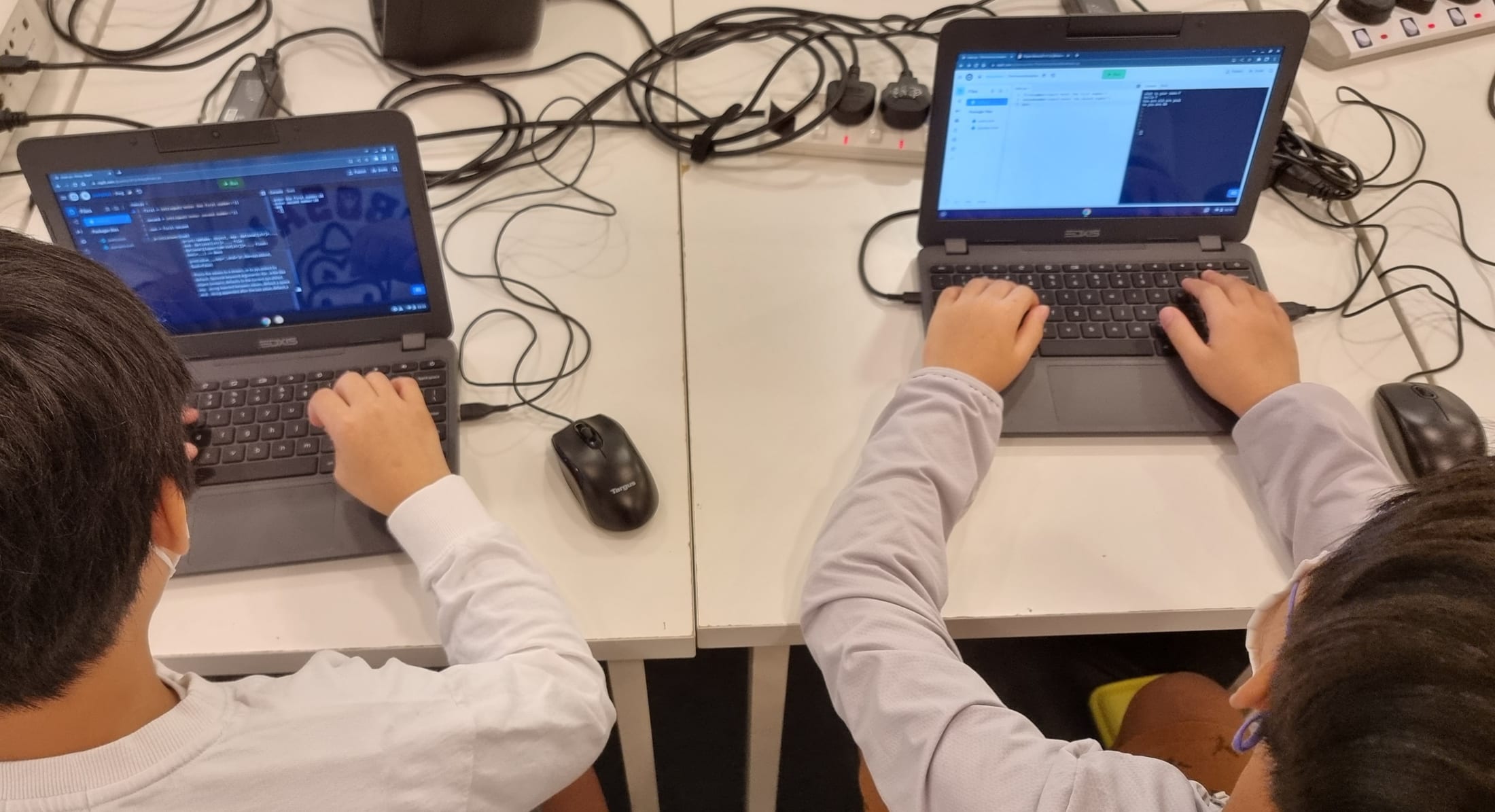
This is probably the most common question I get from parents who have already decided their child should learn to code: should they start with Scratch, or go straight to Python?
The framing is slightly off, and that's worth fixing first. These aren't competing options where picking one means missing out on the other. They're two stages of the same journey, and the only real question is where your child should join it.
Quick Answer: Scratch first if your child is under about 10, Python from around 10 to 12. Scratch teaches the logic of programming — sequence, conditions, loops, variables — without the friction of typing exact syntax. Python teaches the same logic in the form professionals actually use. Most kids spend six months to a year on block-based tools, then move across. Moving too early frustrates them; staying too long bores them.
What Scratch Actually Teaches
Scratch gets dismissed as "not real coding" fairly often, usually by people who haven't watched a child debug a Scratch project. The blocks are a delivery mechanism, not a simplification of the ideas.
A child building a Scratch game is working with the same concepts as any programmer:
- Sequence — things happen in the order you put them, which is less obvious to a seven-year-old than you'd think.
- Conditions — if the sprite touches the edge, bounce.
- Loops — repeat this until the score hits ten.
- Variables — a score that goes up, lives that go down.
- Events — when this sprite is clicked, do that.
What Scratch removes is the typing. No semicolons, no spelling mistakes, no cryptic error messages. A child who drags the wrong block sees the wrong behaviour immediately and fixes it. That tight loop between "I changed something" and "I can see what it did" is what builds confidence, and it's the entire reason block-based tools exist.
What Changes When You Move to Python
The ideas don't change. The precision does.
In Python, a missing colon stops the program. A misspelled variable name stops the program. The computer becomes unforgiving in a way that a nine-year-old can find genuinely upsetting, and a twelve-year-old usually finds interesting.
That shift is the point, not a side effect. Learning to read an error message and work out what it's telling you is a real skill, and it doesn't come from blocks. It's also the skill that transfers everywhere afterwards — to web development, to AI, to any language your child picks up later.
Python is also where the projects stop being toys. Kids can automate something boring, analyse a set of numbers, or build the small language model we teach in our AI course. Those aren't things you can do convincingly in Scratch.
So Which Should My Child Start With?
Use reading and typing as the guide, not enthusiasm.
Under 8: Scratch, almost always. A child who is still working hard at reading will spend all their energy on the text rather than the logic.
8 to 10: Scratch first, but expect them to move on within the year. This is the sweet spot for block-based work — old enough to plan a project, young enough that typing is still a tax.
10 to 12: Either. If they've done Scratch, move them across. If they're starting fresh and can type reasonably, going straight to Python is fine, though many kids enjoy a few weeks of blocks first to get the concepts without the syntax.
12 and up: Python directly. Most teens find Scratch's visual style off-putting, and they don't need the scaffolding.
There's a useful middle route too. Scripting in Roblox with Luau is typed code, but the payoff is a game your child actually wants to play — which carries a lot of kids through the frustrating early weeks of text-based programming. That's why our Roblox course works well as a bridge for 7 to 12 year olds.
How Long Should a Child Stay on Scratch?
Six months to a year of regular work is typical. The signal to move isn't a calendar date, it's a ceiling.
Watch for a child who has built the same kind of project three times and isn't getting more ambitious, or who starts saying their game "can't" do something that it genuinely can't do in Scratch. That's a child who has outgrown the tool and needs more room, not more practice.
Signs Your Child Is Ready for Python
- They can plan a project before building it, rather than dragging blocks and seeing what happens.
- They debug on purpose — changing one thing at a time to find the problem.
- They can type a sentence without hunting for every letter.
- They've asked how "real" programs are made, or noticed that the apps they use don't look like Scratch.
If two or three of those are true, they're ready, whatever their age.
Where to Start
If your child is 7 to 12 and new to coding, Roblox Game Dev gives them blocks-to-code progression with a game at the end of it. From around 12, Python Programming is the direct route — 12 weeks, real code, real projects.
Not sure which fits? That's exactly what the free trial is for. Classes run in person at our Jurong East studio or live online, in groups of up to 12, and every course starts with a free 45-minute trial lesson. Book one and we'll tell you honestly which level suits your child.
