"My child wants to make games" covers a lot of ground. A 7-year-old means something different by it than a 15-year-old, and the game development course that suits one will bore or bury the other.
So rather than one recommendation, here is how game development courses in Singapore line up by age, what your child actually learns at each stage, and how to tell when they're ready for the next one.
Quick Answer: Under 7, start with free game-design puzzles like the Singapore Robot Maze. From 7 to 12, Roblox coding classes suit most kids: the platform is familiar and they script in Luau, a real language. From 12 to 17, a Construct 3 game development course gives teens standalone games, more control over design, and a clear path into JavaScript or Python. Whatever the age, the course should end with a game your child designed themselves.
Ages 6 to 8: Learn What a Game Is Made Of
At this age, the goal isn't to build a whole game. It's to understand the parts: rules, levels, obstacles that move in patterns, timers, and a way to win.
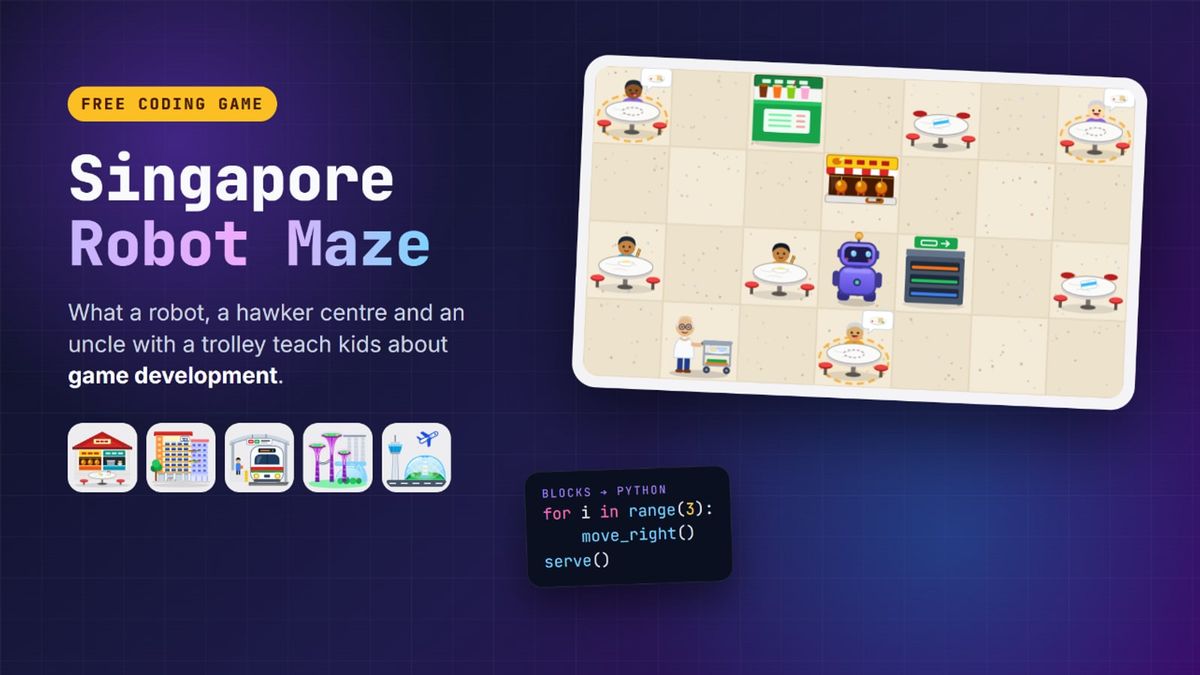
That's why we built the free Singapore Robot Maze, a block-coding puzzle game set in a hawker centre, an MRT station and Changi Airport. Kids snap together blocks to guide a robot, and along the way they meet the building blocks of every game: a trolley uncle who patrols on a fixed route, gates that open on a timer, stars for solving a level efficiently.
Our post on what a robot maze teaches about making games explains what to point out while your child plays. No sign-up, and it works on a tablet.
Ready to move on when: they start asking "can I make my own level?" That's the moment to start building.
Ages 7 to 12: Roblox Game Development
For most primary school kids, Roblox is the best first game development course. They already know the platform, Roblox Studio is a real game engine, and a finished game can be shared with friends from a single link, which matters enormously at this age.
More importantly, it's real coding. Kids script in Luau, a text-based language, using the same ideas as any other programming language: events, variables, loops and functions. Our parent's guide to Roblox coding covers what they learn in detail.
In our Roblox coding classes for kids, students aged 7 to 12 spend 12 lessons going from world building to scripting, scoring and leaderboards, then publish their own game and present it at demo day.
Ready to move on when: they're 12 or older and want more control over how their game looks and plays than Roblox allows, or they've started to find Roblox a bit "young".
Ages 12 to 17: Game Development With Construct 3
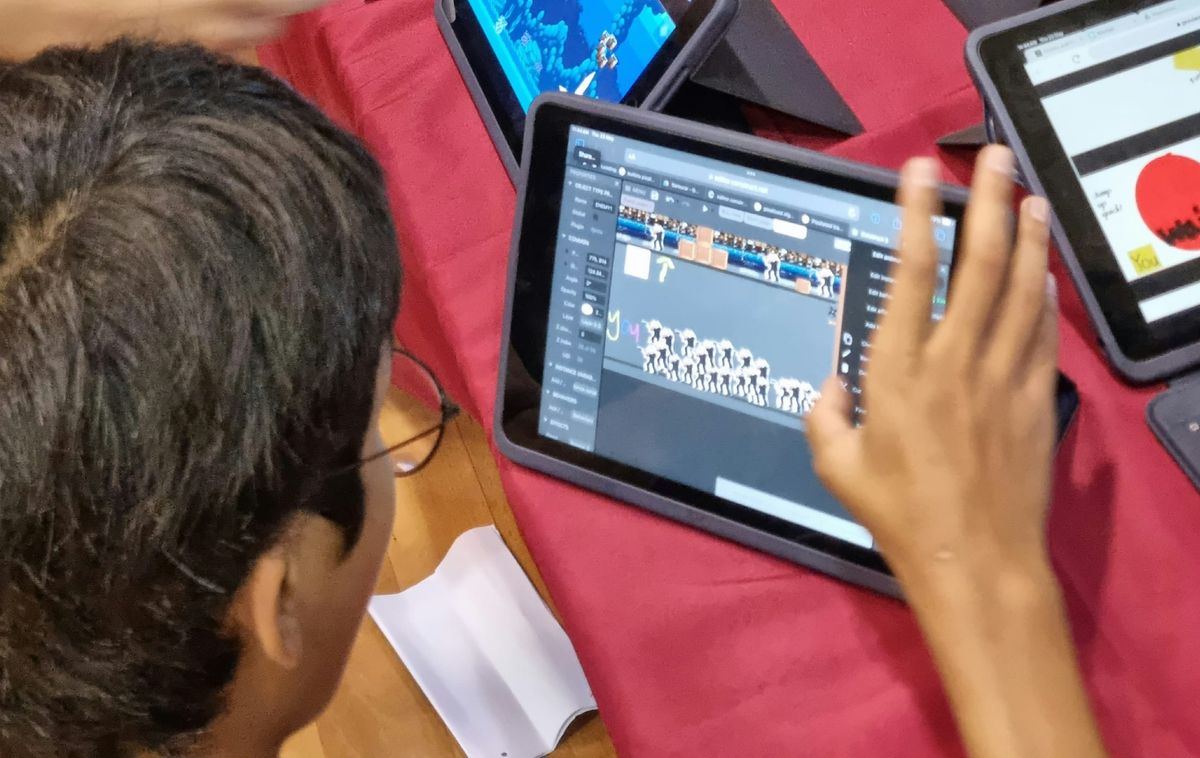
Teens want to make their game, not a Roblox experience. That's where Construct 3 comes in: a professional 2D game engine that runs in the browser, with nothing to install and no gaming laptop needed.
Construct 3 expresses logic as events and actions rather than typed syntax. That sounds like a step back from Luau, but it isn't. It lets teens spend their effort on the hard part, which is designing systems: making the enemy take damage only if the bullet is the player's, the enemy isn't already dead, and the level hasn't ended. That conditional reasoning is exactly what programmers do all day. Our post on game development for teens explains why it counts as real programming, and is honest about what it does and doesn't lead to.
Our game development course for teens runs 10 lessons of 1.5 hours. Teens build an arcade game, a multi-level platformer and a top-down game, then design an original game of their own, playtest it with classmates, publish it to the web and present it at demo day.
Ready to move on when: they've finished a game and want to go further. Construct 3 supports JavaScript, and the logic carries straight into Python.
What If My Child Is 12?
Twelve is where the two overlap, and either can work. A rough rule:
- Choose Roblox if they play Roblox a lot, their friends do too, and the idea of publishing something their friends can join is what excites them.
- Choose Construct 3 if they're more interested in designing the game itself, like how it looks, how it feels and how hard it is, or they've already outgrown Roblox.
If you're not sure, a free trial lesson usually settles it within the first half hour.
What Every Good Game Development Course Should Have
Whatever the age, a few things separate a course that teaches real skills from one that hands out templates:
- An original final game, not a copy of the teacher's.
- Small groups, because every student's bug is different.
- Playtesting, where students watch someone else play their game and fix what confuses them.
- A published game your child can share with a link.
We go through these in more depth, with questions to ask before you book, in our guide to choosing a game development course in Singapore.
Getting Started
All our game development courses run in groups of up to 12, in person at our Jurong East studio or live online:
- Ages 7 to 12: Roblox coding classes for kids
- Ages 12 to 17: Game development with Construct 3
Every course starts with a free trial lesson. Book one, or let your child try the Robot Maze tonight and see whether they ask to build their own level.